

PlantForensics : Industrial Plant Playback & Process Intelligence
Features
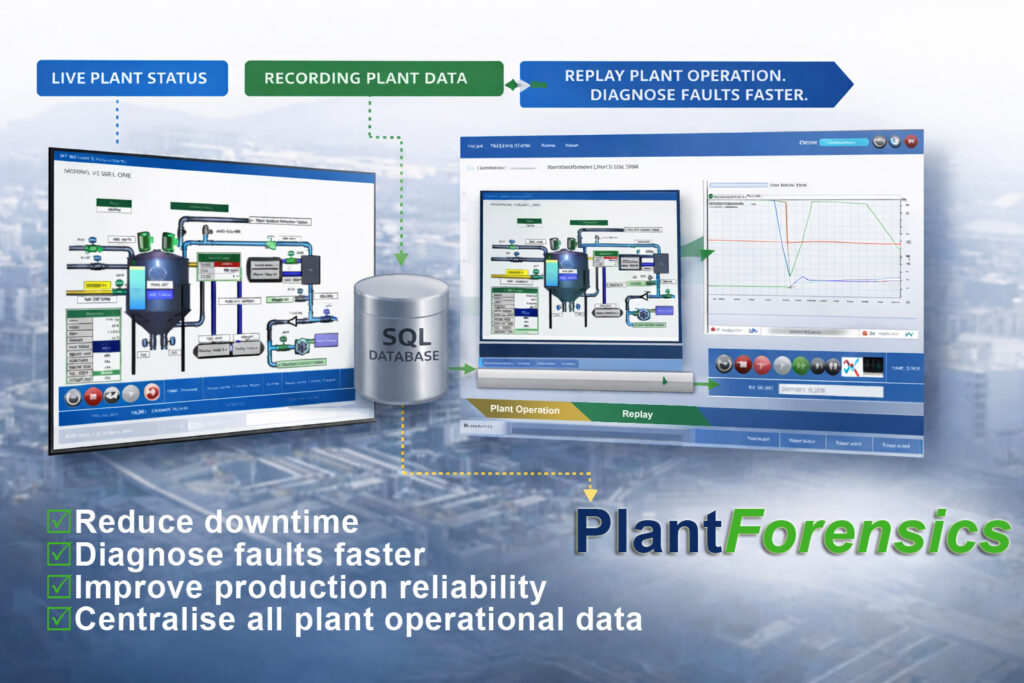
PlantForensics turns plant automation data into replayable evidence—so teams can diagnose faults faster, reduce downtime, and make confident decisions on what actually happened.
- View the live state of the plant
- Plant automation playback rewind to date/time
- Replay the process forward to analyse events
- Condition monitoring with user-defined rules
- Email/SMS notifications and escalation
- Historical event search queries, analysis & export
- Investigate alarms, trips and quality issues
- Smart data recording (tolerance-based capture)
Key Benefits
- Increased operational insight
- Better evidence-based decision making
- Proactive alerts to reduce downtime impact
- Faster root-cause analysis and fault diagnosis
- Reduced downtime through quicker recovery
- Improved quality traceability and investigation
- Scalable architecture for additional lines/assets
- Improved plant visibility

|

|

|

|

|
Plant Playback | Automation Playback | Process Intelligence
Most sites already have SCADA screens, PLC data and alarm logs—but when something goes wrong, it’s still hard to prove what actually happened, and in what order. PlantForensics gives you plant playback—also known as automation playback—to rewind and prove what happened. It also adds event search, condition monitoring, and email/SMS alerts (where configured) so teams can spot issues earlier and respond faster. The result: faster investigations, evidence-based decision making, fewer repeat faults, and quicker recovery after trips and events.
Capture, replay and analyse your plant operation—so you can diagnose faults faster, reduce downtime, and turn raw automation data into actionable operational insight.
- Rewind to any historical date/time and see exactly what happened before, during and after a fault
- Replay the process forward to investigate alarms, trips, events and quality issues
- Centralise plant data from SCADA systems, PLC control systems, remote I/O, and smart devices/sensors
- Store high-resolution event data in Microsoft SQL for search, analysis and export
- Scalable architecture that grows with additional lines, tanks, assets and sites
What PlantForensics Does (In Plain English)
PlantForensics records meaningful operational changes of your plant and then lets you replay your plant operation like a DVR or a blackbox flight recorder.
That means less guessing, faster root-cause analysis, and better decisions backed by evidence.
If your team regularly asks:
- “What changed right before the trip?”
- “Was the operator sequence correct?”
- “Did the valve really open, or did the signal drop?”
- “Why did quality drift on that batch?”
PlantForensics gives you the timeline.
See more details about PlantForensics
Automation Playback: What It Means and Why It Matters
Plant automation playback is the ability to replay the automation system state—PLC conditions, SCADA tags, alarms, sequences and process values—over a chosen time window. Instead of relying on operator notes or partial alarm summaries, PlantForensics lets you rewind and replay the automation timeline to see what changed first, what changed because of it, and how the plant responded.
Automation playback common use cases include::
- Intermittent faults (“ghost faults”) that clear before investigation
- Trips caused by sequence/permissive timing issues
- Alarm fatigue where the initiating event is unclear
- Comparing normal vs abnormal runs to identify the difference
- Proving whether an actuator/sensor state changed as expected
How PlantForensics Captures, Records & Replays Plant Data
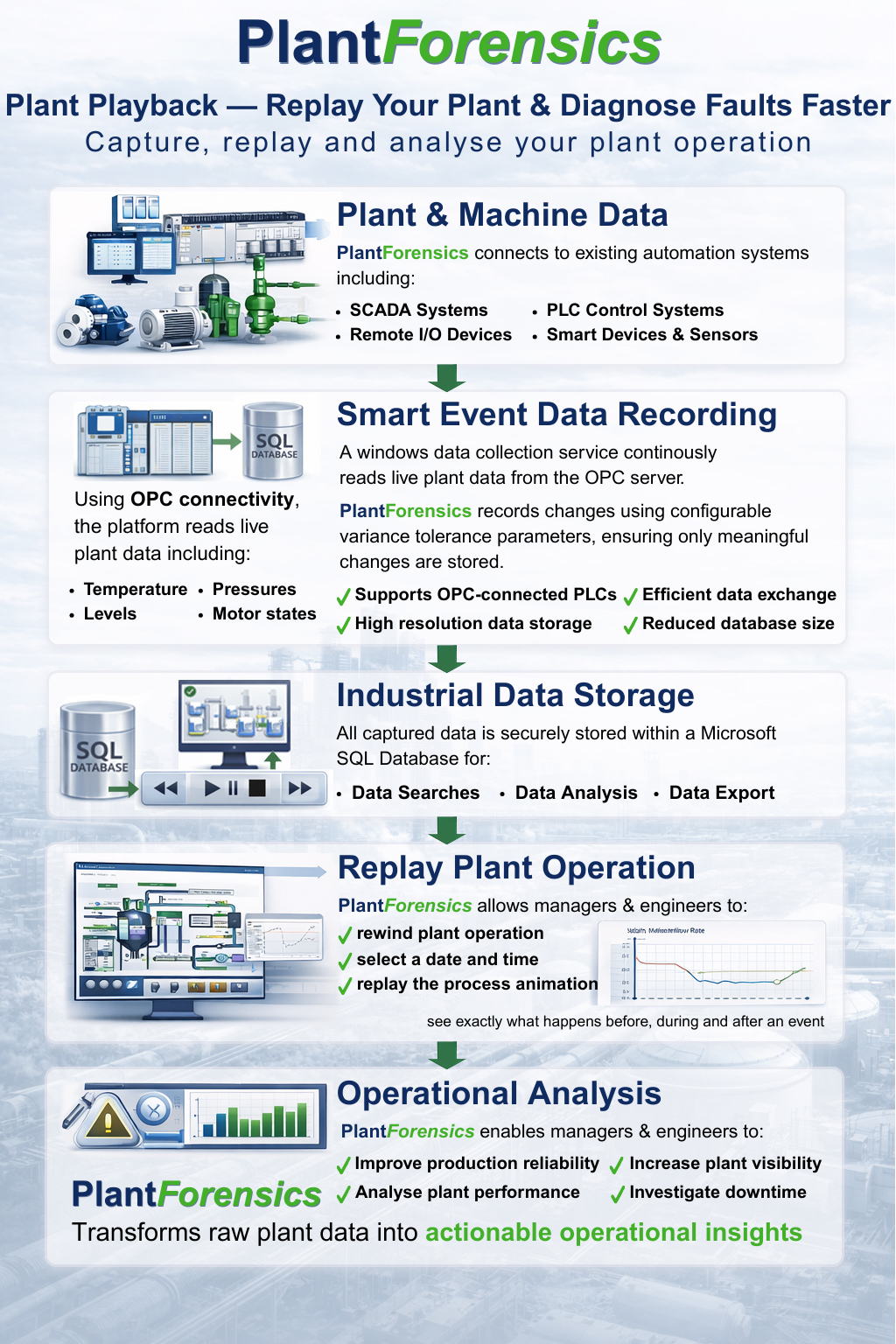
Connect to your existing automation systems
PlantForensics connects to:
- SCADA systems
- PLC control systems
- Remote I/O devices
- Smart devices and sensors
Capture data using OPC connectivity
Using OPC connectivity, PlantForensics reads live plant data (e.g. temperatures, pressures, levels, motor states and more) and records changes.
Smart Event Data Recording (record what matters)
Rather than flooding your database, PlantForensics records changes using configurable variance/tolerance parameters—so you capture meaningful events while keeping storage efficient.
Benefits:
- Reduced database growth by avoiding noise
- High-resolution data where it matters
- Efficient data exchange
- Supports multiple PLC brands (where OPC connectivity is available)
Event Search, Data Queries & Condition Monitoring
Connect to your existing automation systems
Playback is powerful—but PlantForensics becomes business-critical when teams can find the right moment fast and get notified automatically. PlantForensics includes query tools to search historical operational events and a configurable condition monitor that can alert individuals or teams when predefined conditions are detected.
Historical Event Search & Data Query Options
PlantForensics stores operational changes in SQL so you can query and filter historical events instead of manually scrubbing timelines. Engineers and managers can quickly isolate the window that matters—before, during and after a fault, deviation, or downtime event.
Typical query use cases include:
- Find “first change” indicators leading up to a trip
- Compare event timelines between “good” and “bad” runs
- Export query results for investigation reports and continuous improvement
Plant Condition Monitoring (Rules-Based Detection)
PlantForensics can monitor live or recorded data against predefined conditions—so you don’t need to wait for someone to notice a trend or an operator to report an issue. Conditions can be set up to detect abnormal behaviour such as limit breaches, missing states, unexpected sequences, or sustained deviations.
Examples of conditions you can configure:
- Temperature/pressure/level outside permitted band for a defined duration
- Motor state mismatch (e.g., commanded ON but feedback OFF)
- Repeated nuisance trips within a time window
- Process step taking too long or sequence not completing
- “Not running when expected” during scheduled production windows
Email & SMS Alerts (Notify the Right People Fast)
When a condition is detected, PlantForensics can trigger notifications so the right team is informed immediately—reducing response time and limiting downtime impact.
Notification options can include:
- Email alerts to individuals or distribution lists
- SMS alerts for critical events (where configured)
- Time-stamped event records for audit and investigation
The Business Outcomes (Why You Should Buy This)
This is where PlantForensics earns its keep.
Faster fault diagnosis
When alarms/trips or events hit, time disappears. PlantForensics lets you:
- rewind to the exact time window
- replay the process animation
- see what changed first vs what changed because of it
Reduced downtime + more stable operations
Better diagnosis means:
- shorter investigations
- fewer repeat faults
- faster recovery after trips & events
Improved quality traceability
When quality drifts, you need more than “the trend looked odd.” PlantForensics helps you prove what was happening operationally across the same timeline—supporting investigations and continuous improvement.
Increased operational insight
Managers and engineers can use playback and analysis to:
- validate operating procedures
- identify bottlenecks and recurring disruptions
- spot hidden dependencies (sequence, interlocks, timing issues)
PlantForensics is often deployed alongside recipe execution systems such as Batch Control Systems for Recipe Batch Blending and Recipe Dispensary Weighing to support faster investigations and better traceability across the full workflow.
Typical Use Cases
PlantForensics is a fit if your site regularly experiences:
- Trips or events that take too long to diagnose
- Intermittent faults that “clear themselves”
- Quality issues where the timeline is unclear
- Disputes over what happened vs what was reported
Alarm and trip investigation
When a trip happens, the biggest cost is time lost to guesswork. PlantForensics lets you rewind to the exact time window, replay the process state, and identify what changed first—so you can separate the root cause from the knock-on effects.
PlantForensics helps you:
- Rewind to the minutes before the trip and see the initiating condition
- Validate whether permissives/interlocks were met in the correct sequence
- Speed up incident reviews with a shared, evidence-based timeline
Batch/sequence validation
For batch, blending, and recipe-driven processes, it’s not enough to know the final outcome—you need to prove the sequence and timing were correct. PlantForensics provides plant playback to verify that critical steps occurred when they should have, supporting troubleshooting and quality investigations.
PlantForensics helps you:
- Confirm whether steps executed in the intended order and time window
- Check for skipped actions, early transitions, or unexpected holds
- Compare “good batch vs bad batch” behaviours using the same playback approach
“Ghost faults” and intermittent issues
Intermittent faults are costly because they disappear before anyone can see them. PlantForensics captures operational changes and lets you replay the event window—helping you diagnose rare behaviours that don’t show up in standard alarm summaries or operator notes.
PlantForensics helps you:
- Investigate short-lived signal changes, nuisance trips, and unexplained stops & events
- Correlate process conditions to fault occurrences (timing, state changes, trends)
- Reduce repeat callouts by finding the real pattern behind “random” failures
Quality deviation and traceability investigations
When quality drifts, the cause is often operational: timing, conditions, sequences, or control behaviour. PlantForensics gives you a replayable record of what the plant was doing around the event, supporting faster investigations and more confident corrective actions.
PlantForensics helps you:
- Rewind to see what changed during the deviation window
- Verify process conditions and operating states before/during/after the issue
- Improve CAPA and continuous improvement with evidence-backed timelines
Operator shift handover and incident reviews
Shift teams often inherit issues without the context of what happened earlier. PlantForensics makes it easy to review plant behaviour during a defined time window, improving handover quality and reducing the time spent repeating checks.
PlantForensics helps you:
- Review the event timeline during shift change or morning meetings
- Reduce “we think it was…” conversations with a shared playback view
- Improve standard work by learning from real events and outcomes
Multi-area visibility across plant mimics
For sites with multiple process areas, investigations often stall because the data is fragmented. PlantForensics supports multiple plant views and can help teams see related events across different assets—especially where upstream changes cause downstream disruptions.
PlantForensics helps you:
- Centralise visibility across multiple mimics/areas for faster investigation
- Cross-check upstream/downstream dependencies (e.g., supply/transfer states)
- Scale playback and analysis as you add lines, tanks, or equipment
Integrations and Architecture
PlantForensics is designed to sit alongside existing systems:
- Works with OPC-connected environments
- Stores data in Microsoft SQL
- Complements SCADA/HMI by adding playback and process intelligence tools
- Scales as you add more tags/assets/lines
If you need full plant supervisory control and reporting, see our SCADA Systems & PLC Control Systems solutions.
If you need engineered integration, PLC/SCADA modifications, panels or commissioning support, our team also provides Bespoke Control Systems Design and Engineering.
FAQs
Is PlantForensics SCADA?
PlantForensics complements SCADA. SCADA provides live supervision and control. PlantForensics adds plant playback, investigation tools, and process intelligence based on recorded operational changes.
What do you need to connect PlantForensics?
Typically an OPC connection to your automation environment. We’ll review your PLC/SCADA architecture and recommend the safest, most maintainable integration approach.
Does PlantForensics store everything?
It’s designed to store meaningful changes using configurable tolerance parameters—so you get useful insight without unnecessary database growth.
Can I search historical events without manually replaying the timeline?
Yes. PlantForensics includes query tools to filter historical operational events by time window, asset/area and event type—so you can find the right moment fast and then replay only what matters.
Does PlantForensics support condition monitoring and notifications?
Yes. PlantForensics can monitor predefined conditions and send notifications by email or SMS (where configured), helping teams respond quickly to abnormal behaviour and reduce downtime impact.
Can we export data for reporting?
Yes—data is stored in SQL for searching, analysis and export.
Can it support multiple areas or sites?
Yes—PlantForensics is designed with a scalable architecture and can support multiple plant views and expansion over time.
Request a Demo
If you want faster fault diagnosis, better traceability, and fewer “we think it was…” investigations, PlantForensics is built for exactly that.
Request a demo and we’ll show how PlantForensics can connect to your SCADA/PLC environment and start delivering operational insight quickly.
|
|
|
|
|
|
If you have any questions or would like further information about the Practicon PlantForensics System, please contact us.
Recommended...

Read more about Industrial SCADA & PLC Control System Integration
Industrial SCADA & PLC Control System Integration Practicon designs, integrates and commissions industrial SCADA and PLC control systems for manufacturers and their process plants and machines. From new automation projects and control system upgrades to PLC programming, SCADA integration and legacy system replacement, our engineers deliver complete control solutions from initial specification through to installation, […]

Read more about Bespoke Control Systems Design, PLC Programming & Control Panel Build
Bespoke control systems and control engineering Practicon designs and delivers bespoke control systems for industrial automation—covering control engineering, PLC control systems, panel build, integration and commissioning. Bespoke control systems are engineered around your equipment, process constraints, site standards and future expansion plans. Practicon provides end-to-end control engineering—from requirements capture and control philosophy through design, build, […]

Read more about Batch Control System for Recipe Blending & Automated Batching
Batch Control System for Recipe Batch Blending & Automated Batching Ingredient Batching Systems for Automated Manufacturing If you have any questions or would like further information about the Practicon proTrace Recipe Batching Systems, please contact us.

Read more about Recipe Management System for Dispensary Weighing
Recipe Management System for Dispensary Weighing & Batch Control Dispensary Weighing & Recipe Control Systems for Accurate, Compliant Batch Production Manual or poorly controlled dispensary weighing often results in batch inconsistencies, material waste, and compliance risks—especially in busy production environments. The proTrace Recipe Management System provides precision-controlled weighing, operator guidance, and full batch traceability, ensuring […]

Read more about Tank Farm Loading & Off Loading Systems
Automated Solutions for Safe, Accurate, and Traceable Material Transfer Practicon designs and implements intelligent tank farm distribution and tanker loading/offloading systems that streamline bulk material handling in industrial plants. Our PLC and SCADA based control systems provide precise material management, ensuring safe, compliant, and efficient operations across liquid and powder transfer processes. Powder and Liquid […]
